
Roots and Shoots: A StACCS-funded community collaborative pilot project begins

What do sea grass planting, Victorian botanical recipes, fabric dying, the Celtic tree calendar, dulce soup, vernacular plant names and flood alleviation have in common? They are all themes being considered by three community heritage organisations as part of a new UK-wide exploratory project funded by StACCS called “Roots and Shoots: Growing climate resilience and regeneration through traditional ecological knowledge and skills exchange” (01 November 2025 – 31 July 2026).
Professor Karen Brown and Dr Victoria McMillan from the School of Art History are leading this project in collaboration with three community heritage organisations from Scotland (Skye Ecomuseum), Wales (Ecoamgueddfa Llŷn), and England (Canalside Heritage Centre in partnership with Beeston Civic Society), to explore critical sustainabilities through the transmission and revitalisation of traditional plant knowledge across generations and communities.
Community knowledge sharing and learning will be led by local specialists and young leaders who will experience peer-to peer support to facilitate three workshops, one in each community, exploring how plant-based knowledge supports biocultural heritage, biodiversity and ecosystem services.

Image: Traditional Pen Llyn clawdd (pl. cloddiau) – a stone-faced earth bank with old Hawthorn hedging on top supporting numerous flora and fauna species in the Ecoamgueddfa area. Photo, Victoria McMillan
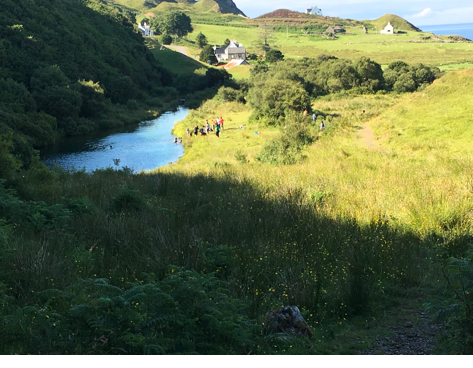
Image: Wildflower meadows full of plants traditionally used for healing and health surround the sacred Loch Shianta, Isle of Skye Youth Exchange. Photo, Karen Brown
Collaborative planning meetings have begun to explore ideas for the three participatory workshops that will happen between March and May 2026. Already, this is stimulating the strengthening of existing, and the building of new, relationships within each of the communities, as the partner organisations reach out to their wider communities for other groups and individuals to be involved in planning, delivery and participation of community workshops. Children and teachers from a primary school in each area will also participate in the project.
The workshops will facilitate knowledge and skills exchange at the local level. Exploring local cultural keystone species and plant names, uses, mythology, stories, music, arts and memories, we will engage with traditional plant lore from the everyday to the sacred, alongside planting medicinal and vegetable gardens, indigenous trees, wildflower mini-meadows and seagrass regeneration and gathering wild harvests. Meanwhile, creative methods will be used to document, celebrate, and safeguard traditional plant lore for the communities.
Inter-community knowledge and skills exchange will be facilitated as partner organisation steering groups meet online throughout the project to share ideas and experiences. The school groups are planning to create their own mini-exchange through online connections but also old-fashioned posting of letters and drawings between the children.
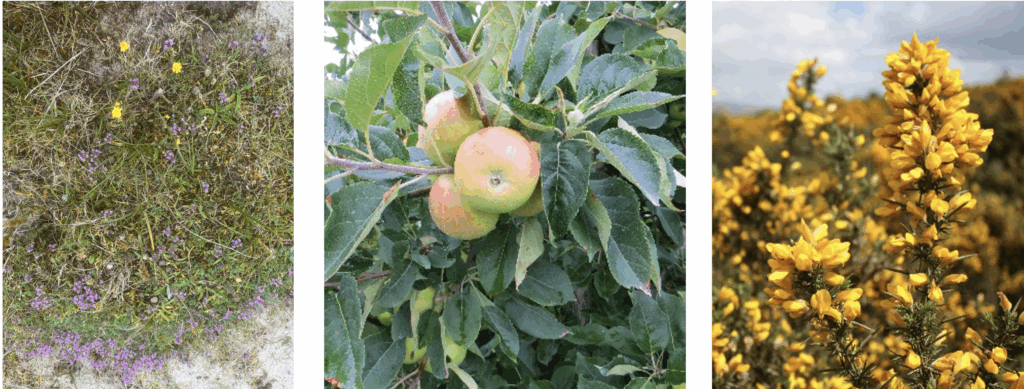
Image: Hebridean Machair, Bramley Apples, Beeston. Common Gorse, Pen Llyn. Photos Karen Brown and Victoria McMillan
At its foundation, the project is about strengthening and building relationships and connections, identity and belonging – roots and shoots. In June 2026, Karen and Victoria will co-chair an international Webinar series bringing together community partners, academics, support agencies, and policymakers for a joint knowledge and skills-sharing discussion on community heritage resilience in the face of global change. On this occasion, StACCS and Roots and Shoots will join forces with cognate research projects, including the Shared Island Stories project (2022-27) coordinated by Karen, and a Museum and Heritage Studies student placement. In this forum, the community collaborators will be given space as equal participants, holders and producers of knowledge, cultural narratives and sustainability strategies, alongside specialist academic knowledge in a two-way flow. Ultimately, as these exchanges increase awareness and understanding, it is hoped that our shared research will also strengthen relationships, empathy, and care between human and nonhuman communities, and between people and their places, increasing resilience, stewardship, and mutual flourishing. The seeds have been cast. Watch this space for updates on how the project grows.
Blog post by Victoria McMillan and Karen Brown